
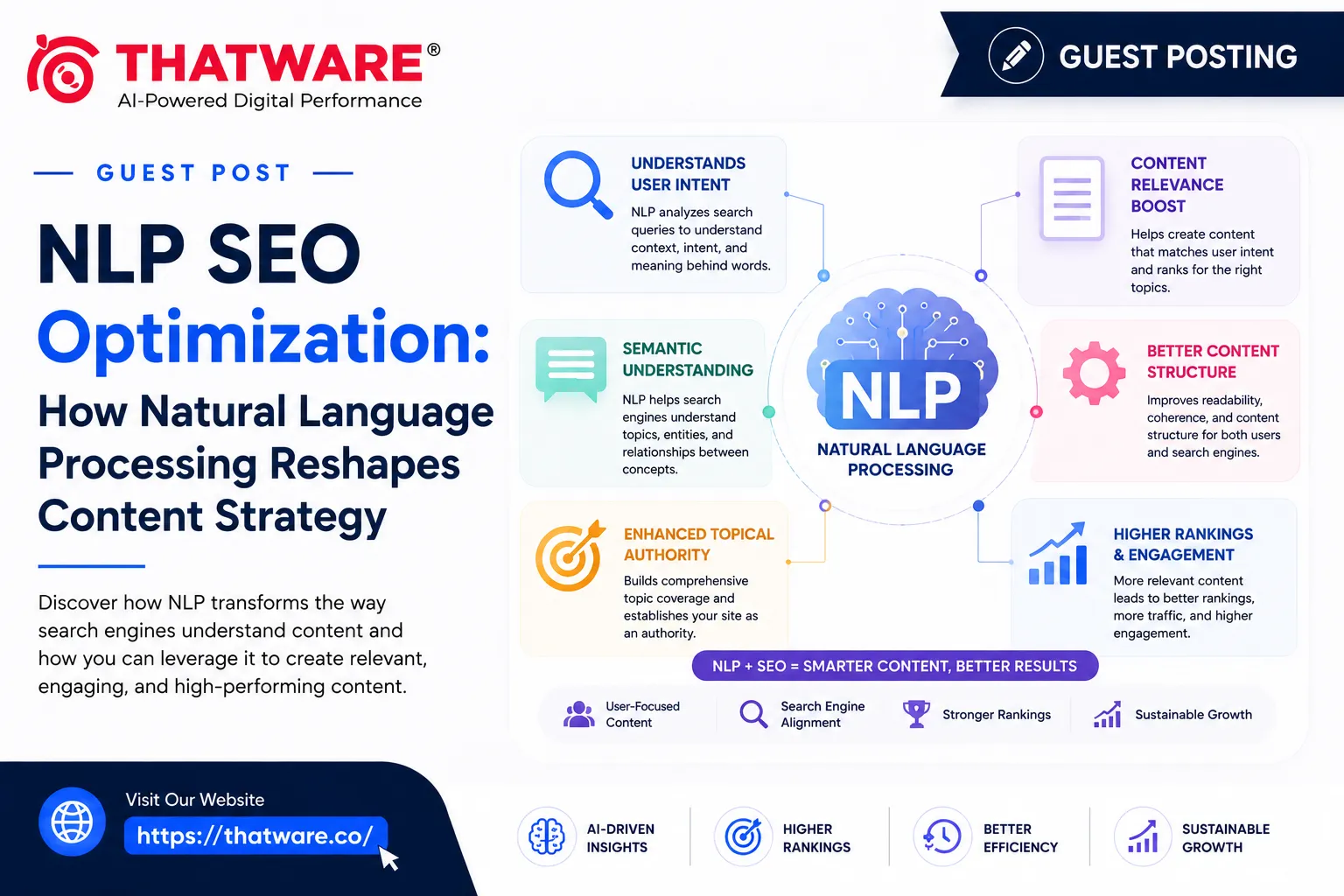
There’s a version of content strategy that used to work reasonably well: find a keyword, write something about it, make sure the keyword appears enough times, get some links, rank. The logic was simple because the underlying system was simple. Search engines were essentially very sophisticated concordance indexes — they matched words in queries to words in documents.
That model hasn’t been fully accurate for several years now. It’s been dying a slow death with every major algorithm update. BERT, MUM, RankBrain, and the various transformer-based advances underneath Google’s current infrastructure haven’t just made search “smarter” in a vague sense — they’ve fundamentally changed what search engines are actually reading when they evaluate your content.
They’re reading meaning now, not just words.
What NLP Actually Means in a Search Context
Natural Language Processing is the branch of AI that enables machines to understand, interpret, and generate human language. In the context of search, NLP allows engines to move beyond keyword matching into semantic understanding — grasping the intent behind a query, the relationships between concepts, and the overall meaning of a piece of content.
BERT (Bidirectional Encoder Representations from Transformers) was a significant public milestone here. Before BERT, Google processed search queries largely left to right. BERT introduced bidirectional processing — understanding a word in the context of all the words around it, both before and after. A query like “can you get medicine for someone pharmacy” is parsed completely differently when “for someone” is understood in context rather than just matched as isolated words.
This shift means content that’s built around keyword density and thin topical coverage is being evaluated by a system that’s trying to understand if the content genuinely addresses a need — not just whether certain terms appear on the page.
Entity-Based Optimization
One of the most practical implications of NLP in SEO is the shift toward entity-based optimization. An entity, in search terminology, is a real-world object or concept — a person, place, organization, idea — that search engines recognize and track relationships between.
Working with an NLP SEO optimization company means getting serious about entities: identifying which entities are central to your topic, ensuring your content establishes clear relationships between them, and building coverage that reflects how your topic fits into the broader knowledge graph Google is maintaining.
This is concretely different from keyword optimization. A keyword is a string of text. An entity is a concept with relationships. “Apple” as a keyword appears on pages about fruit, technology, and many other things. “Apple Inc.” as an entity has specific relationships to other entities — Tim Cook, iPhone, Cupertino, the App Store — and content that establishes and explores those relationships is evaluated very differently than content that just mentions “Apple” frequently.
Semantic Breadth vs. Keyword Depth
Traditional content strategy concentrated on ranking for specific terms, which led to content that went deep on a narrow topic — often repetitively. The unspoken logic was: more mentions of the keyword = more relevance for that keyword.
NLP-informed content strategy inverts this. The most competitive pages in most niches are winning not because they mention their primary keyword more, but because they cover the conceptual neighborhood of that keyword more completely. They answer adjacent questions. They address related entities. They establish the kind of topical completeness that signals genuine expertise rather than targeted keyword placement.
Semantic AI SEO services operationalize this by mapping what Google considers the full semantic scope of a topic — the entities, the related queries, the co-occurring concepts — and then auditing content against that map. The gap analysis tells you not what keywords to add, but what conceptual ground to cover.
Writing for Intent, Not Queries
NLP advances have also sharpened how we should think about search intent. Queries are what people type. Intent is what they’re actually trying to accomplish. These overlap but they’re not the same thing.
A query like “running shoes review” contains at least three distinct intents: someone who wants an overview of top options, someone specifically looking for trail running shoes, and someone who typed the wrong thing because they actually wanted to buy, not just research. Google’s NLP capabilities allow it to model which interpretation is most likely for a given search, and to evaluate whether content addresses that interpretation or misses it.
Content briefs built on NLP analysis focus on intent above all — not what the page says about a topic, but what question it genuinely answers and how completely it answers it. This changes both the structure and the depth of content significantly.
Practical Implications for Your Content Process
If you’re not already building NLP analysis into your content workflow, the gap between your pages and those of competitors who are is growing. Not because their writing is better — in many cases it isn’t — but because it’s more semantically complete, more intentionally structured around how search engines are actually evaluating meaning.
The practical starting points: audit your existing high-potential pages for entity coverage gaps, restructure briefs to address intent explicitly rather than keyword placement, and invest in semantic analysis tools that reveal what the topic space actually looks like rather than just reporting search volume.
Language is how humans understand the world. NLP is how machines are learning to do the same. Content strategy that doesn’t account for this is optimizing for a version of search that’s already been obsolete for years.
